
Apr 20, 2026
Egypt: An Ancient Civilisation, the Nile and the Desert

There is a particular kind of silence that descends the moment you pass through the entrance of an Egyptian temple: when the noise of the world outside falls away and you find yourself in conversation with walls that have been speaking, in paint and stone, for three thousand years. This is the Egypt we have set out to find. Not the Egypt of the crowded coach park, but a country in which history is not curated behind glass but pressed into the very rock beneath your feet.
Our new 16-day journey, from the Greco-Roman pavements of Alexandria to the desert wind of the Fayoum Oasis, is an immersion in the oldest continuous civilisation on earth. We travel in a small group, at an unhurried pace, partly on a dahabiya of our own: a shallow two-masted wooden boat, moored at villages that the great cruise ships sail past without stopping. This is Egypt as it rewards the curious.

Alexandria & Rosetta: Where Civilisations Converged
We begin not in the south, where most Egypt itineraries set their sights, but on the Mediterranean shore, in a city that has been reinventing itself since 332 BC. Alexander the Great chose this strip of coastline personally, reportedly tracing the outline of his city in grain on the ground, and what he built became the intellectual capital of the ancient world for centuries.
The Bibliotheca Alexandrina we visit today is the modern heir to the most famous library in history. At its peak, the ancient Library of Alexandria is thought to have held half a million scrolls, gathered from every corner of the known world on the orders of Ptolemy I, one of Alexander's successors. Among those housed within its walls were Euclid, who refined geometry, and Eratosthenes, who calculated the circumference of the earth to within 1% accuracy using little more than a shadow and a well. When the library declined and finally fell, an entire chapter of classical thought went with it.
The Greco-Roman Museum tells the story of what happened next: three centuries of Ptolemaic rule in which Egyptian religion and Greek aesthetics fused into something entirely new. You will see the jackal-headed Anubis, ancient Egypt's guardian of the afterlife and keeper of the scales on which a soul's worth was weighed, wearing the breastplate of a Roman soldier. Cultures in conversation, even in death.
An hour's drive brings us to Rosetta (Rashid), where the Nile meets the Mediterranean, and where, in 1799, a French officer named Bouchard noticed an unusual black stone embedded in a wall he was demolishing. What he had found was the Rosetta Stone: a decree issued in 196 BC, during the reign of Ptolemy V, inscribed in three scripts: hieroglyphics, Demotic, and ancient Greek. Twenty-three years later, Jean-Francois Champollion used it to do what scholars had attempted and failed to do for centuries: read ancient Egyptian. The silence of the pharaohs ended in a French scholar's study. We visit Fort Julien, where the Stone was found, before taking to the Nile by boat.
We return to Alexandria to descend into the Catacombs of Kom es-Shoqafa: a Roman-era necropolis carved three levels deep into the rock, blending the imagery of Osiris and Anubis with classical architectural motifs. There is something quietly extraordinary about standing in a chamber built by people who could not decide if they were Greek, Egyptian, or Roman, and finding that in their uncertainty, they created something wholly their own.

The Overnight Train South: Into Upper Egypt
We board the overnight sleeper train in Alexandria and wake, a thousand kilometres later, in Aswan, a city at the edge of the ancient world. Here the Nile, so flat and wide in the north, narrows between granite outcrops and breaks around islands thick with palms. This is Upper Egypt, though it sits to the south: the Nile flows north, and so 'upper' means upstream, closer to its source in central Africa. The ancient Egyptians called this boundary Elephantine, the island around which we will walk, named either for its resemblance to an elephant's hide or for the ivory trade that passed through it. Either way, it was a frontier.
The Nubian Museum in Aswan does justice to the civilisation that flourished here, south of the first cataract, before, during, and long after the great pharaonic dynasties. The Nubians were traders, warriors, and on more than one occasion, rulers of Egypt itself. The 25th Dynasty, the so-called Kushite Dynasty, was Nubian, and its pharaohs built more pyramids than any Egyptian dynasty before or after them.

Abu Simbel: A Temple Written in Light
The drive south to Abu Simbel takes us along the shore of Lake Nasser, the vast reservoir created by the High Dam, a lake so large it altered the regional climate. We arrive at the sandstone cliffs and find ourselves before the four seated colossi of Ramses II, each one twenty metres tall, cut directly from the living rock. Ramses II, who ruled for 66 years, from around 1279 to 1213 BC, and fathered well over a hundred children, was perhaps the greatest self-publicist in human history. His face appears on monuments from the Delta to deep into Nubia. And yet Abu Simbel is more than an exercise in royal ego.
The temple was aligned with extraordinary astronomical precision. Twice a year, on 22nd February and 22nd October, traditionally believed to mark the anniversary of Ramses' coronation and his birthday, the rising sun penetrates the 60-metre corridor and illuminates the statues of three gods within the innermost sanctuary: Ra-Horakhty, Amun-Ra, and the deified Ramses II himself. Only the fourth figure, Ptah, god of the underworld, remains permanently in shadow. This is not coincidence. It is engineering of the highest order, carried out without instruments we would recognise.
The second miracle of Abu Simbel is more recent. When the High Dam was built and Lake Nasser began to rise in the 1960s, the entire complex, all 24,000 tonnes of it, was cut into over a thousand blocks and reassembled on higher ground, 64 metres above its original site. The astronomical alignment was preserved to within a day. We pause for a moment in the innermost chamber and consider both achievements.
![4.[5]](filemanager/4.[5].png)
The Dahabiya: Egypt at Walking Pace
There is no better way to understand the Nile than to live on it. In Aswan, we board our privately chartered dahabiya, a wooden two-masted vessel, shallow-draughted enough to glide close to the banks, with ensuite cabins, a shaded upper deck, and a cook who sources ingredients from the markets we visit along the way. For three nights, the river is our road.
The dahabiya was the preferred vessel of 19th-century travellers. Gustave Flaubert sailed one in 1849, Florence Nightingale in 1850. Unlike the great cruise ships that ply the Luxor-Aswan route, our dahabiya can pause wherever curiosity leads.
At Kom Ombo, we step ashore to visit one of Egypt's most unusual temples: a sanctuary split precisely down the middle and dedicated to two rival deities. The southern half belongs to Sobek, the crocodile-headed god of fertility and of the Nile's power to create and to flood, whose sacred animals were kept in pools within the temple precinct. The northern half honours Horus the Elder, the falcon-headed god of kingship, son of Osiris and Isis, whose battle against his uncle Seth for the throne of Egypt is perhaps the oldest royal succession narrative in the world. The two cults coexisted here, their separate inner sanctuaries served by separate priesthoods, united under one roof. Egypt was rarely so tidy as its mythology suggests.
We walk the quarry galleries at Gebel El Silsila, where the very sandstone from which Luxor's temples were built was cut, before sailing on to Edfu Temple. Dedicated to Horus, begun under Ptolemy III in 237 BC and completed 180 years later, Edfu is the best-preserved temple in Egypt. Its walls carry the fullest surviving account of the Contendings of Horus and Seth, the great mythological struggle in which the universe hung in the balance. Reading those reliefs, with a guide who can translate them, is something else entirely.
We spend a morning on Bisaw Island with its 350 inhabitants: breadmaking on a rooftop, fishing by rowing boat, mangos and date palms and quiet conversation. The ancient world and the living one, side by side.

Thebes: The City That Ruled the World
Disembarking at Esna, we visit the Temple of Khnum, the ram-headed god tasked, according to Egyptian theology, with fashioning both the bodies and souls of humans on his potter's wheel. The temple here was begun under Ptolemy VI and, astonishingly, is still yielding discoveries: excavations in 2021 revealed painted reliefs of previously unknown Roman emperors, their cartouches freshly legible after millennia of grime.
Then we drive to Luxor, built on the ruins of ancient Thebes, Homer's 'city of a hundred gates.' At the height of the New Kingdom, from around 1550 to 1070 BC, Thebes was the greatest city on earth, the capital of an empire that stretched from the Euphrates to the fourth cataract of the Nile. Its temples consumed more stone than any other building project in history.
Karnak is the largest religious complex ever built. Begun under the Middle Kingdom and added to by almost every pharaoh of the New Kingdom, it covers two square kilometres and contains a sacred lake, a processional avenue of ram-headed sphinxes, and the Great Hypostyle Hall: a forest of 134 papyrus-form columns, the tallest reaching 23 metres, every surface carved with the histories of kings and the names of gods. To stand inside and look up is to understand how a temple could replace mountains as the closest thing to the divine.
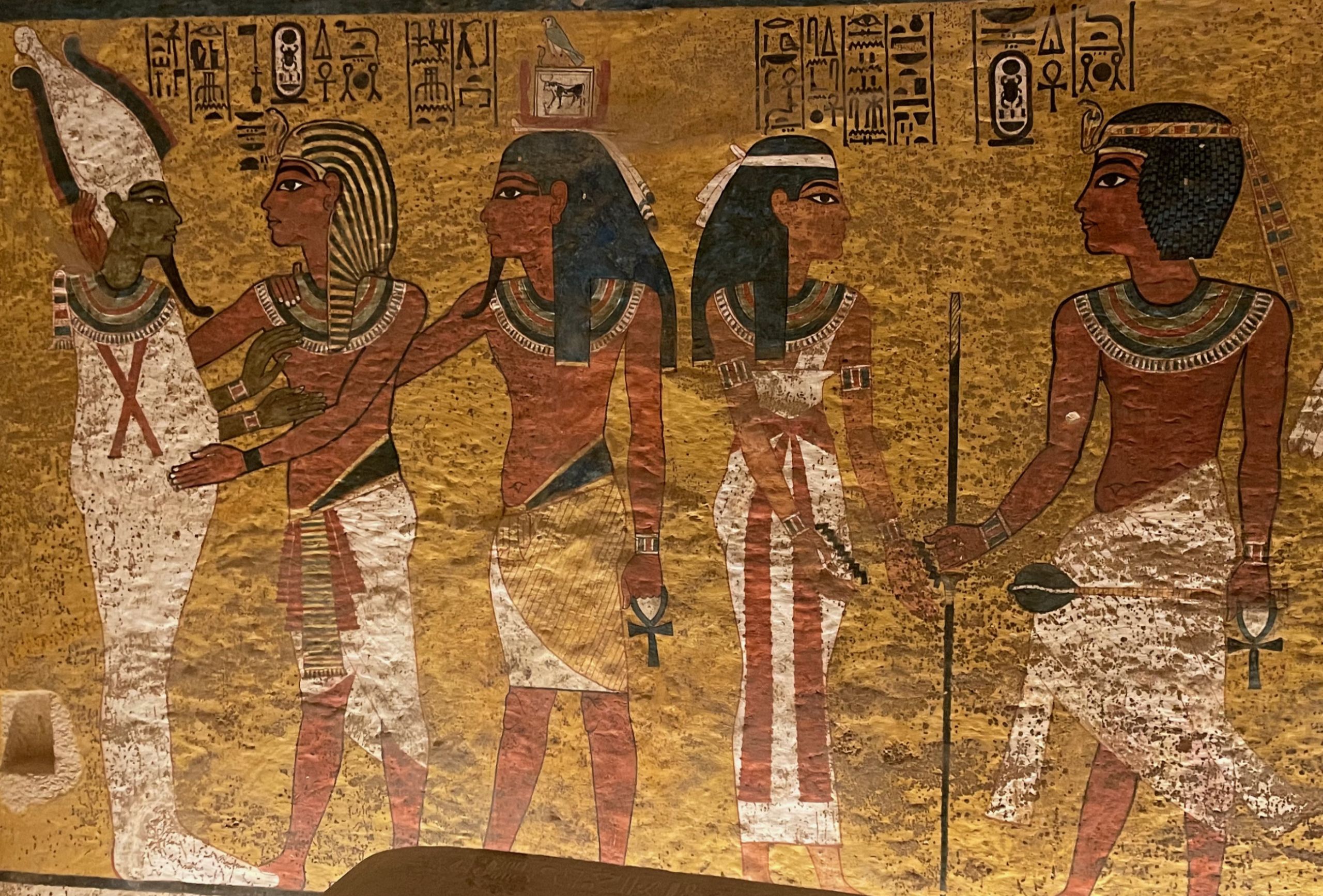
On the West Bank, the land of the setting sun and the land of the dead, we visit the Valley of the Kings. Here, for five centuries, pharaohs abandoned the pyramid in favour of rock-cut tombs hidden in a remote limestone valley. The reasoning was practical: pyramids advertised what lay within. The Valley, they hoped, offered secrecy. It largely did not, as most tombs were robbed in antiquity. The exception is the most famous: Tutankhamun, a boy king who died at around nineteen, whose tomb was discovered virtually intact by Howard Carter in 1922 and whose treasures we will see in their new home at the Grand Egyptian Museum in Cairo. Of the three tombs we explore in the Valley, each tells its own version of the Egyptian afterlife: a journey through the Duat, the underworld, guided by Anubis, judged by Osiris, threatened by serpents and rewarded with eternal light.
We also visit Hatshepsut's Mortuary Temple at Deir el-Bahri: a structure of breathtaking colonnaded terraces cut into the cliffs, built for a ruler who wore a false beard, took the title of pharaoh, and oversaw one of the most peaceful and prosperous reigns in Egyptian history. After her death, her successor, possibly out of rivalry, possibly out of political necessity, had her image chiselled from many of the reliefs. She was rediscovered by Egyptologists in the 19th century, when they began to notice a peculiar absence where a pharaoh should have been.
In the afternoon, we wander through Medinet Habu, the great mortuary temple of Ramses III, which sees a fraction of the visitors it deserves. Its walls record, in extraordinary carved detail, the naval battles of the Sea Peoples, mysterious raiders who threatened Egypt around 1175 BC and whose origin scholars still debate. The colours here are extraordinary, protected by centuries of desert sand.

Cairo: The Last Wonder and the Lost Civilisation
We arrive in Cairo, the largest city in Africa, in the Arab world, in the Middle East, and check into the cosmopolitan Zamalek district, an island in the Nile. The Grand Egyptian Museum at Giza is the new home of the Tutankhamun treasures: over five thousand objects found in his four-roomed tomb, including the golden death mask, the gilded shrines, the alabaster canopic jars, and the extraordinary golden throne whose back panel shows the young king and his wife Ankhesenamun in a moment of intimate domesticity that feels startlingly human across thirty-three centuries.
At Giza, we stand before the Great Pyramid of Khufu: 146 metres tall at its completion, built with approximately 2.3 million stone blocks, each averaging two and a half tonnes, constructed over roughly twenty years around 2560 BC. How? We know more than we once did: a workers' village has been excavated nearby, revealing a well-organised, well-fed workforce of skilled craftsmen rather than the enslaved multitudes of popular imagination. But the engineering remains a matter of productive debate. We also see the Sphinx, the largest monolithic sculpture in the world, carved from a single limestone outcrop, combining the body of a lion with the head, most Egyptologists believe, of Khafre, Khufu's son. The Sphinx looks east, towards the rising sun. It has been looking there for 4,500 years.
The Fayoum: Desert, Oasis, and Deep Time
Our final couple of days take us west into the Western desert, into the Fayoum Oasis, fed by Nile water through ancient canals and cupped around a natural lake that has shrunk, over millennia, from an inland sea. Here, on the northern shore of Lake Qarun, we discover an ancient pharaonic road of basalt, a 7th-century cave monastery, and the remains of a trading post founded in the 3rd century BC. History in layers, as Egypt always offers.
We end at Wadi Al Hitan, the Valley of the Whales, a UNESCO World Heritage Site in the open desert where the fossils of Archaeoceti, the ancestors of modern whales, lie in the sandstone. These were creatures that had recently left the land for the sea, their hind legs still partially formed. The valley puts five thousand years of human history into perspective. Even the pharaohs are recent arrivals here.

A Note on How We Travel
This is not a holiday built around the famous sites alone, though those sites will stop you in your tracks. It is built around the spaces between: the sleeper train rattling south through the night, the dahabiya chef carrying vegetables back from a village market, and a night in a potters’ village on the shores of the Fayoum lake, to list just a few examples.
Our group travels as 6 to 14 guests. All meals are included, as are the services of a Kudu tour leader throughout, specialist local guides at sites, and a privately chartered dahabiya on the Nile. We stay in hotels chosen for character: a historic property in central Alexandria, a garden hotel in Aswan, a small charming west-bank hotel in Luxor, and a village guesthouse in the Fayoum.
Egypt rewards the attentive traveller. We have designed this journey for those who want to be exactly that. For more information about our next tour date and itinerary please click here.